Beat Ballz
- 4.3
- Rating
- 10.00M
- Installs
- Free
- Price

 Analysis by App-foxy
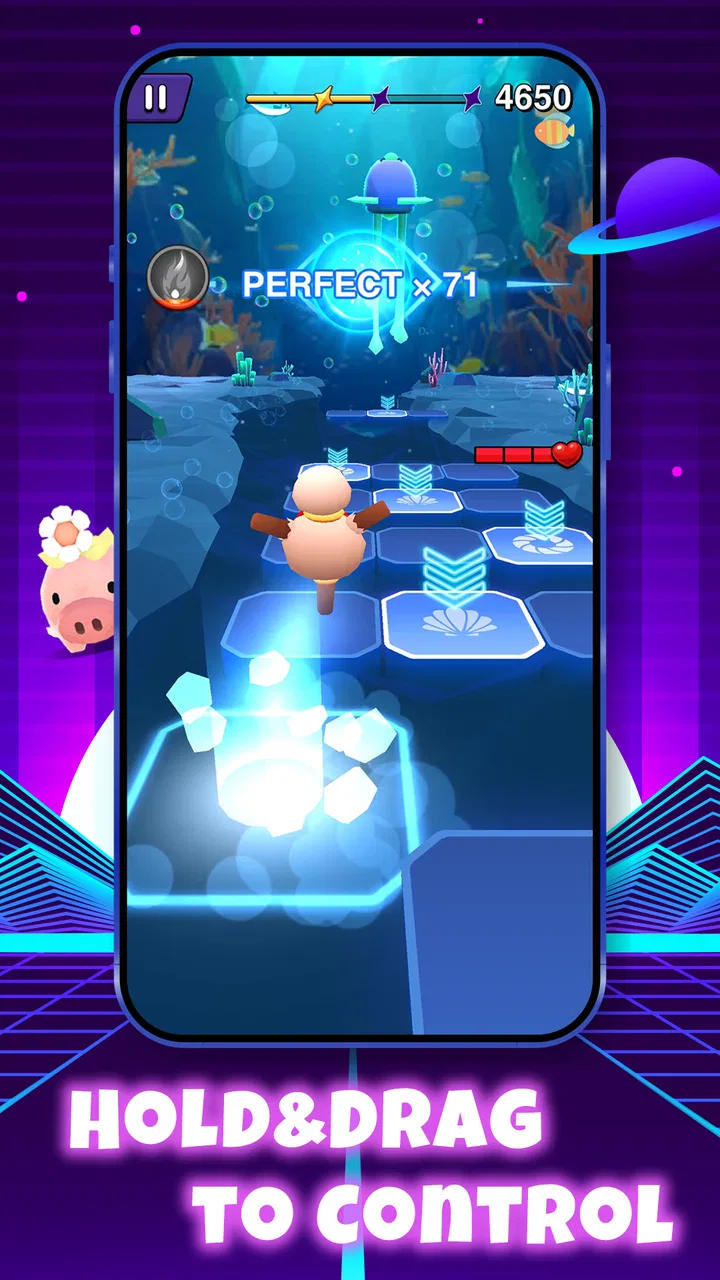
I spent time with Dream Hop - 3D Magic Dash as a quick music game built around jumping from tile to tile in a colorful three-dimensional scene. The basic idea is easy to understand: listen, watch the path, and guide the ball through the rhythm without losing the flow. It sits in the music-game corner rather than trying to be a full action adventure, so the appeal comes from short bursts of concentration, visual timing, and the satisfaction of matching movement to a track.
My first impression was that it is designed for immediate play. There is no need to learn a complicated control scheme before trying a song, and that makes it a natural choice when I want something lighter than a long session-based game. At the same time, the 3D presentation gives it more personality than a completely flat tile runner. The important question is whether that visual layer helps the rhythm or gets in the way. In my experience, it does both, depending on how busy the scene becomes and how comfortable you are with visual movement.
How the pace feels during ordinary play
The perceived speed in a game like this is not only about how quickly the ball moves. It also depends on how much time I have to read the next tile, recognize a change in direction, and react to the beat. Dream Hop feels approachable at the beginning because the central action is simple, but the concentration requirement rises quickly when the path demands more precise timing. That creates a useful contrast: the game is easy to start, yet it can still make a short attempt feel active.
You May Also Like

 Blood Strike: 2.5 Anniversary
Blood Strike’s Loadouts Turn Every Drop Into a Tactical Gamble
A close look at Blood Strike’s custom loadouts: how fast access to signature weapons reshapes its battle royale rhythm, rewards preparation, and narrows the gap between fights.

 Pandora - Music & Podcasts
Pandora’s Music Is Easy to Start, but Harder to Recover
Pandora’s strength is its low-effort path from a seed to a station. Its weak spot is how much confidence it asks you to place in connection, setup, and quiet recovery.

 8 Ball Pool
 Is Built on Rivalries, Rematches, and Routine
A close look at the rivalries, rematches, shared routines, and unanswered safety questions that turn a quick pool match into a persistent mobile community.

 Samsung Music
’s Quiet Strength Is Playing What You Already Own
Its reach comes less from spectacle than from dependable access to a personal library. That simplicity is both the app’s strongest retention engine and its ceiling.

 AccuWeather: Weather Radar
AccuWeather Review: A Quick, Clear Forecast for Everyday Decisions
For everyday plans, the best forecast is the one you can understand quickly. AccuWeather makes rain timing, radar, and local conditions easy to act on, with a few trade-offs.

 Hill Climb Racing
Why Hill Climb Racing Still Turns Crashes Into One More Run
A tiny car, a bumpy hill and one more upgrade: Hill Climb Racing keeps resurfacing because its simple chaos makes every near-miss feel personal.
More From Our News Desk



I found the best rhythm by treating each run as a listening exercise rather than staring only at the ball. The music gives me a sense of when to prepare, while the tile layout tells me where to move. If I focus too heavily on the colorful 3D scenery, I am more likely to react late. A practical tip is to keep attention near the next landing point, not the center of the screen. That small adjustment makes the game feel less frantic and gives the visual effects less opportunity to distract me.
This also explains why the game can suit different moods. I can play casually when I want to follow the music without caring about a perfect run, or I can repeat a section because the timing feels just slightly outside my control. It is not the same kind of relaxation as listening to music passively. My hands remain involved, and even a short session asks for enough focus that I would not call it background entertainment.
The short-session nature is one of its strongest practical qualities. I can pick it up while waiting for an appointment or take a few attempts during a break without needing to remember a complex story or manage a large inventory. That convenience is more meaningful than it sounds: music games often work best when the restart is immediate and the goal is clear. Dream Hop has the right general shape for that use, although players who prefer long-form progression may find the repeated timing loop narrow.
Reading the scene instead of chasing the ball
The 3D viewpoint changes how I approach each attempt. In a two-dimensional rhythm game, the play area can feel more like a fixed diagram. Here, depth and movement can make the next tile feel closer or farther away than expected. I learned to use the route itself as the main visual guide and to regard decorative movement as secondary. That is a small but important distinction for anyone who becomes disoriented by animated backgrounds or changing perspectives.
Another useful habit is to avoid making a last-second correction unless the path clearly requires it. When I move too late, the problem is often not my finger speed but my reading of the route. Preparing for the next tile as soon as it becomes visible gives me a calmer response window. This is especially helpful for younger players or anyone who normally struggles with rhythm games because of visual overload.
The game’s Teen content rating is worth keeping in mind for families deciding whether it is suitable for a younger player. The rating does not change the basic control idea, but parents should still check the experience directly and consider the presence of optional purchases before handing over a device. For me, that is a more useful approach than assuming every colorful music game is automatically aimed at children.
What happens when I play repeatedly or push a session
During heavier use, the main demand comes from the combination of continuous touch input, music playback, and a moving 3D scene. I would not treat it like a passive audio app. The screen is doing real work throughout a run, and the player is constantly processing timing information. On a device that already struggles with modern games, the visual presentation may feel more demanding than a simple flat rhythm title, even though the controls remain uncomplicated.
That distinction matters when choosing where to play. On a newer phone or tablet, the 3D style is part of the fun because it makes each jump feel more like a small performance. On an older or lower-powered device, I would prioritize clear visibility and consistent touch response over visual spectacle. If the game feels less comfortable after several attempts, I would first close other demanding apps, make sure the device is not already warm, and then try again. Those are ordinary steps, but they are particularly relevant to a game that combines animation, sound, and repeated input.
I also noticed a human form of performance pressure: after several failed attempts, I tend to rush. That can make the game seem faster even when the real problem is impatience. Taking a short pause between runs helps me return to the beat instead of tapping in reaction to frustration. This is one of the less obvious trade-offs of Dream Hop. Its quick restart structure encourages “one more try,” which is convenient, but it can also turn a short break into a longer session than intended.
For battery-conscious players, I would use it differently from a lightweight puzzle game. A few brief runs are a sensible everyday pattern, while extended play with the display bright and the sound active is naturally more demanding than reading or messaging. I would not choose it as my default game during a long trip if battery preservation were the priority. A simpler, less animated music title would be the safer choice for that situation.
When the visual style helps and when it gets in the way
The 3D scene gives Dream Hop a stronger sense of motion than a basic lane-based rhythm game. I enjoy that extra feeling of traveling through a musical space, especially when I am playing with sound on and allowing the scene to support the beat. The drawback is that depth can compete with precision. If I am trying to improve a run, I care less about the scenery and more about whether the next landing point is immediately readable.
My workaround is to play in a quiet environment and keep the phone at a comfortable viewing angle. That sounds ordinary, but it reduces the number of competing signals I have to process. I would also avoid playing while walking or in a moving vehicle. The combination of real-world motion and a shifting game perspective is not ideal for accurate timing, and a missed jump in that situation feels more like a setup problem than a fair test of skill.
Sound is equally important. Since this is a music-focused game, muting it removes part of the timing information that makes the format work. If I need to play quietly, headphones are more useful than lowering the volume until the beat disappears. Players who want a completely silent game should probably choose a visual puzzle instead, because Dream Hop’s identity is tied to the relationship between what I hear and what I see.
Reliability, recovery, and the practical side of restarting
For this kind of game, reliability is not only about whether it opens. It is also about whether I can recover from a mistake without losing the desire to continue. Dream Hop benefits from having a straightforward central loop: attempt a run, learn from the miss, and try again. That makes failure easier to accept than in a game where a mistake costs a long buildup of progress.
My most useful recovery technique is to identify why I missed rather than immediately blaming the controls. There are usually three possibilities: I listened late, I read the tile path incorrectly, or I moved too aggressively. Separating those causes makes practice more productive. If the issue is audio timing, I focus on the beat. If it is visual confusion, I watch the route earlier. If it is overcorrection, I make smaller movements. This turns repetition into deliberate practice instead of random tapping.
The recovery loop is also why I would recommend it more readily to someone curious about rhythm games than to someone seeking a deep campaign. A newcomer can understand the goal almost immediately and improve through repetition. A player who expects detailed character development, exploration, or a broad collection of unrelated activities may feel that the experience stays too focused. Dream Hop is at its best when I accept that its purpose is concentrated musical play.
There is another practical point for shared devices. Because the game is built around timing, handing the phone to another person does not require a long explanation. I can show the basic movement and let the next player learn by trying. That makes it a reasonable casual choice for friends or family members who do not usually play mobile games. Still, the Teen rating and optional purchases mean I would not leave a child using a shared payment-enabled device without supervision.
The developer is Remaster Games, and the current version is 1.0.50. For everyday users, the version detail matters mainly when troubleshooting: if the experience behaves unexpectedly, checking that the installed build is current is a sensible first step. I would also restart the app after a long session if touch response begins to feel unusual, rather than assuming every missed jump reflects a change in difficulty. A clean relaunch is a simple recovery step for any mobile game that has been running repeatedly.
Device fit, storage expectations, and purchase awareness
The minimum operating-system requirement is Android 8.0, which gives the game a broad potential device range, but compatibility alone does not guarantee an equally comfortable experience on every phone. A device that can install a game may still offer a less pleasant session if its screen is small, its touch response is inconsistent, or its hardware has trouble maintaining a smooth 3D presentation. I would judge suitability by the quality of the run, not only by whether installation is allowed.
A larger screen can make the route easier to read, but it is not automatically better. On a tablet, the distance between the hand and the next tile may feel different, and players who rely on quick thumb movement might prefer a phone. The best fit is the device on which I can see the upcoming path without covering important parts of the display with my finger. That is a personal ergonomics issue, but it has a direct effect on timing.
The game is free to download, with optional in-app purchases ranging from $6.99 to $29.99 per item. I would approach it as a free trial of the core experience and decide later whether any optional purchase adds enough value for my own habits. The important trade-off is not simply the price; it is whether I am comfortable making purchases in a game designed around repeated attempts. If I am prone to spending impulsively after a frustrating run, I would protect the account with purchase controls before playing.
That purchase structure also affects who should skip the game. Anyone looking for a completely purchase-free music experience may be happier with a title that has no optional transactions. Likewise, if I want to hand a device to a child and not think about account settings, I would choose something with a simpler payment environment. Dream Hop remains accessible as a free game, but responsible use requires the same attention I would give any free-to-play title.
Its reach is substantial, with over ten million installs, while the average score is 4.2 from around 4.8 thousand ratings. Those figures suggest that the simple music-and-jumping format has found a sizeable audience, but they should not replace personal testing. A player who enjoys visual rhythm challenges may connect with it immediately, while someone who dislikes repetition or needs a slower, more predictable interface may not. Popularity tells me that the concept works for many people; it does not remove the individual fit question.
How it compares with familiar music-game alternatives
Compared with a traditional tap-to-the-beat game, Dream Hop places more emphasis on movement through space. That gives it a stronger visual identity, but it can also make precision less transparent. In a lane-based alternative, I may know exactly which column is active. Here, I have to interpret the route as it approaches, so the learning curve is more about spatial reading as well as rhythm.
Compared with a simple endless runner, it feels more deliberate because the music provides a timing framework. An ordinary runner may reward quick reactions to obstacles, while this game asks me to connect what I hear with the next jump. If I want a reflex challenge without caring about music, another runner would be a better match. If I want the soundtrack to influence my actions, Dream Hop has the more relevant design.
It also differs from large rhythm games that focus on collecting songs, characters, or long-term progression. I prefer those broader games when I want a hobby that keeps unfolding over many weeks. I prefer Dream Hop when I want an uncomplicated session with one clear skill to practice. The trade-off is depth versus immediacy: this game is easier to enter, but its focused loop may not provide enough variety for players who need constant new systems.
One non-obvious advantage is that its visual and musical demands make it useful for testing my own attention. I can tell whether a mistake comes from hearing the beat, reading the scene, or controlling the movement. That makes it more instructive than a game where failure feels random. The limitation is that this same combination can be tiring. After a long session, I would rather stop than force improvement, especially if the screen begins to feel visually busy.
Who I would recommend it to
I would recommend Dream Hop to someone who wants a free music game that can be understood quickly but still rewards practice. It is a good fit for short breaks, casual competition between friends, and players who enjoy repeating a challenge until their timing improves. It is also a reasonable first step into rhythm games for someone who prefers moving through a 3D scene rather than tapping fixed notes.
I would be more cautious recommending it to people who experience motion sensitivity, dislike bright or busy visual presentation, or need a completely predictable pace. The 3D perspective may make the route harder to read, and the rhythm focus means that playing without sound loses part of the intended experience. Players with older devices should also keep expectations realistic: the minimum system requirement allows installation, but a smoother and more comfortable session depends on the device itself.
For an everyday example, I could see using it during a ten-minute wait: headphones on, a few focused attempts, then closing it before the session becomes tiring. I would not use it while commuting on foot, during a conversation, or when I need to conserve battery. That distinction captures the game well. It is a focused pocket activity, not a background companion for every situation.
My final view is positive but measured. Dream Hop succeeds because it combines an approachable jumping idea with musical timing and a distinctive 3D presentation. Its best moments come when the beat, the next tile, and my movement line up naturally. Its weak points appear when visual motion competes with readability, when repeated attempts become tiring, or when optional purchases make the free-to-play context less comfortable for a shared device.
The performance verdict is simple: it feels most convincing as a short, focused rhythm game on a device that can display its 3D scenes comfortably. I would install it for quick musical challenges, not for a deep adventure or a completely distraction-free experience. If that balance sounds right to you, the free entry point makes it easy to try. If you want a silent, low-demand, purchase-free game with long-term progression, I would choose a different category instead.
FAQs for Beat Ballz
01What is Dream Hop - 3D Magic Dash?
Dream Hop - 3D Magic Dash is an engaging rhythm-based game that combines vibrant visuals and catchy music. Players navigate through a series of challenging levels, hopping and dashing in time with the music. The game is designed for both Android and iOS, offering a captivating experience for music and rhythm game enthusiasts.
02How do I control the character in Dream Hop - 3D Magic Dash?
Controlling your character in Dream Hop - 3D Magic Dash is intuitive and straightforward. Players use simple tap controls to make their character jump and dash through obstacles. Timing is crucial, as each tap must sync with the rhythm of the music to successfully navigate each level and achieve high scores.
03Are there in-app purchases in Dream Hop - 3D Magic Dash?
Yes, Dream Hop - 3D Magic Dash includes in-app purchases. These are typically used to unlock additional levels, purchase new skins, or remove ads. While the game offers a satisfying experience for free, these purchases can enhance the gameplay by providing more customization and content for dedicated players.
04Can I play Dream Hop - 3D Magic Dash offline?
Dream Hop - 3D Magic Dash offers offline play, allowing users to enjoy the game without an internet connection. This feature is convenient for players who want to pass time during travel or in areas with limited connectivity. However, some features, like leaderboards or purchasing items, may require an online connection.
05Is Dream Hop - 3D Magic Dash suitable for all ages?
Dream Hop - 3D Magic Dash is designed to be family-friendly, making it suitable for players of all ages. Its colorful graphics and simple controls appeal to younger audiences, while the challenging levels and rhythm-based gameplay provide a stimulating experience for older players. Parents can feel confident that it is appropriate for children.
Pros
- Immersive 3D graphics enhance gameplay.
- Variety of levels keeps the experience fresh.
- Intuitive controls make it easy to play.
- Regular updates with new features.
- Engaging soundtrack adds to the atmosphere.
Cons
- In-app purchases can be costly.
- Occasional lag on older devices.
- Requires constant internet connection.
- Ads can interrupt gameplay.
- Limited offline content.

Beat Ballz
Gallery